Saturday, 9 July 2011

What's the proper terminology for nebula clouds?

The term "nebula" has been used historically for virtually any astronomical object that was fuzzier than stars. Specifically, galaxies which to the naked eye and in small telescopes looked like elongated clouds were called nebulae (e.g. the Andromeda Nebula), even though they definitely aren't clouds.


Nowadays, the term is mostly used in the context of planetary nebulae, which are the beautifully colored death breaths of low-mass stars, lighted up by a central white dwarf. These objects were originally thought to be planets, but has nothing to do with that.


Other types of nebulae are usually called by their more descriptive names, e.g. molecular clouds, HII regions, and supernova remnants. The only objects I can think of that are often called nebulae, are reflection nebulae, which are the clouds of dust and gas surrounding a young star cluster.

the moon - Why is the Color scheme of natural satellites in our solar system based of light shades of grey?

The colour of a natural satellite is almost entirely based off the atmosphere and surface of the satellite. The moon Io, of Jupiter is not grey and is coloured because of sulfur on its surface that create a colour. Io has a very thin atmosphere.


So that brings us to your question, why is the majority of natural satellites grey? We know that moon's colours are dependent on what they are made up of and if they have an atmosphere, so the basic answer is that the majority of moons are grey because they do not hold an atmosphere, and are made up of rock. Our moon is made out of basalts which are a grey rock. You can probably go out and research what certain moons are made of, and find out more about the rocks on them and how they affect the colour of the planet.

Wednesday, 6 July 2011

Does "Dark Matter" really exist?

The question seems to be based on some misconceptions, so I'll try to clear them up.


Dark matter and dark energy are two completely separate and unrelated concepts. It's unfortunate that many articles trying to entice readers with tales of the unexplored frontiers of astronomy tend to use the phrase "dark matter and dark energy" quite a lot, typically with the buzzwords "mysterious," "unknown," and even "spooky."


Obviously, the best introduction here is to read the Wikipedia articles on dark matter and dark energy. You can also see the and tags (and the questions that use them) for more information. Physics also has some good questions about these topics.


I'll give you the important points:


  • Dark matter . . .


  • Dark energy . . .


    • . . . is responsible for the acceleration of the expansion of the universe, though not the expansion of the universe

    • . . . can be represented by the cosmological constant


The one thing that the two share? We know very little about them.


In fact, it causes more problems than it solves.


You can come up with many different universes that begin with a Big Bang but don't have an accelerated expansion (not counting inflation, though you don't have to have that in a universe under some circumstances). They don't somehow suffer from any problems that universes with dark energy don't have. In fact, they're better because you don't have to somehow explain dark energy.


Courtesy of Rob Jeffries, here's one tidbit about the one fairly important role of dark energy in the Big Bang:


Our universe is close to flat (see the many papers by the WMAP team), and quite a lot of measurements have confirmed that we're not living on some wacky-shaped universe. The issue is that the measurements indicate that the universe isn't quite flat. Again, see the WMAP data. You can attribute part of the percentage offset from flatness to experimental error, or you can attribute it to the idea that perhaps the universe isn't so flat after all.


Dark energy provides an explanation for this inherent not-quite-flat-ness that characterizes our universe. In those other toy universes (without dark matter), you need to explain this near-flatness some other way. Not in our universe, it seems.


Well, sort of. Coming from someone like me (who is firmly on the "theorist" side of the scientific spectrum), that's quite a whopper. But from a certain point of view, it's completely accurate.


Dark matter is actually a theory. It's an explanation for some screwed-up galactic rotation curves, where some stars near the outer edges of a galaxy move much faster than they should.
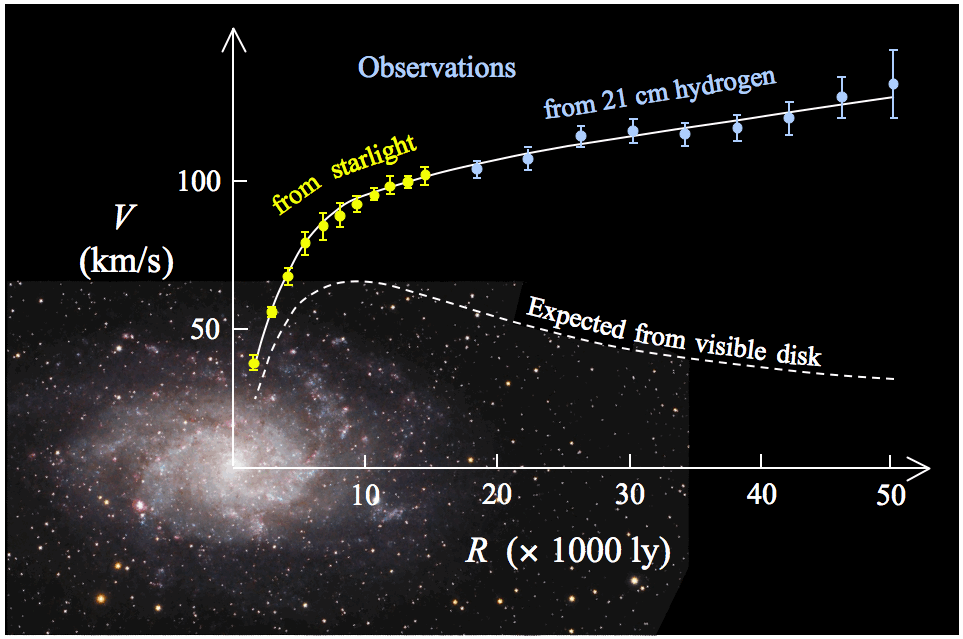


So it's actually a theory to explain a phenomenon.


Dark energy, on the other hand, is an experimental phenomenon. We don't have a good theory to explain it. But it's a phenomenon responsible for many different problems. There's quite a lot of evidence that says, "Something odd is going on."


What I mean by all this is that there's a heck of a lot of evidence for them. Our theories of them were created to explain evidence, and not vice versa (evidence gathered to support or refute a theory).


I advise, once again, that you look at the Wikipedia articles on both concepts to start learning more (especially the sections on evidence). Physics and Astronomy have plenty of good information. arXiv has many pre-prints that may be helpful. And there are lots of books, magazines, and (reputable) web sites that can give you even more detailed information.

the sun - Calculating effective SSN (sunspot number)

I am doing research on SSN like parameters. As I can see effective SSN is a parameter that derived from SSN or may be using other parameters. Do anyone know how to calculate effective SSN.


i.e following file has some parameters ftp://ftp.swpc.noaa.gov/pub/latest/DSD.txt


ref http://spawx.nwra.com/spawx/ssne.html


Thanks

archaeology - How to read Babylonians' tablet that were used to track Jupiter's movements?

There is a science news article on how Babylonians used geometry to track Jupiter’s movements.


Here is an image of cuneiform tablet which shows Jupiter's movements.


From a layman's point of view, it looks like someone engraved gibberish on a tablet. How do we even know it was used to track Jupiter's movements.


Can anyone translate this? Thanks.

Tuesday, 5 July 2011

black hole - Blackhole Finding Techniques

I know of two methods for finding exoplanets: the transit method and the radial velocity method. These two methods work as follows:


  1. Transit: we observe stars and watch for when a planet obstructs the light from the star.


  2. Radial Velocity: detecting the planet by observing the motion of the star and using Kepler's law.


Are these methods also used for discovering black-holes? What are the pros and cons of these methods, I think that the con of transit is that it's difficult to see the black hole. A pro is that it doesn't matter how many stars there are around the black hole.


With the Radial Velocity method, a pro is that it's easy to detect but requires exactly one companion star (I used this source).

Saturday, 2 July 2011

human biology - What actually happens when my leg 'falls asleep'?

The explanation in the link Polynomial posted is essentially correct.


Whenever there is a reduced or blocked blood supply (ischaemia) to your extremities, the 'five P's' can occur: pulselessness, pain, pallor (colour), paresthesia (numbness) and paralysis (or weakness).(1).


The numbness and weakness happen after the blood flow have been reduced for a particularly prolonged period.


Cells in our body require a blood supply to stay alive (think about a stroke or heart attack for example). So a reduced supply can cause them to function abnormally or after a time (depending on the cell or tissue type) die.


So with a 'sleeping leg', staying in an awkward or particular position where arterial blood supply is blocked or reduced to the leg, the muscle, nerve tissue etc all lack supply hence causing sensory disturbance and weakness.


The possible buildup of metabolites could also contribute to the symptoms (pain).


Hope that helps!


  1. Miller's Anaesthesia - Miller.