Tuesday, 10 January 2012

cosmology - On the cosmological principle

Neither of the two cases are completely inconceivable:


A homogeneous, anisotropic universe


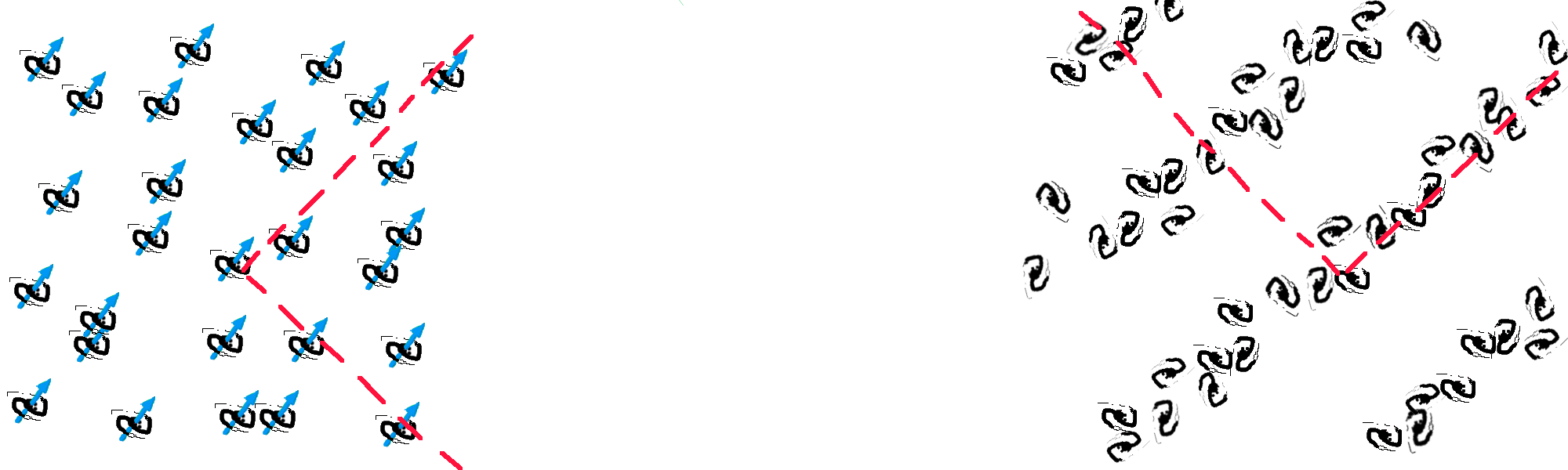
A universe with galaxies spread evenly all over, but all spinning in the same direction. This universe would look the same no matter where you lived, but have a net angular momentum, so looking in one direction you'd see all galaxies spinning along your line of sight, and in another direction, you'd see them spinning perpendicular to this direction.


Another example is a universe that had been permeated by density waves in one direction. In this direction, you'd see the density of galaxies alternating between high and low, and perpendicular hereto you'd see a constant density.


homo-noniso


Yesterday's papers on arXiv included a paper (Schucker 2016) that discusses the the possibility that we might live in another type of homogeneous, anisotropic universe, namely one in which the observed expansion rate depends upon the direction in which you look. This is called a "Bianchi I universe", and isn't just a hypothetical curiosity (although the results of this paper is statisically non-significant). See also @JonesTheAstronomer's answer.


An inhomogeneous, isotropic universe


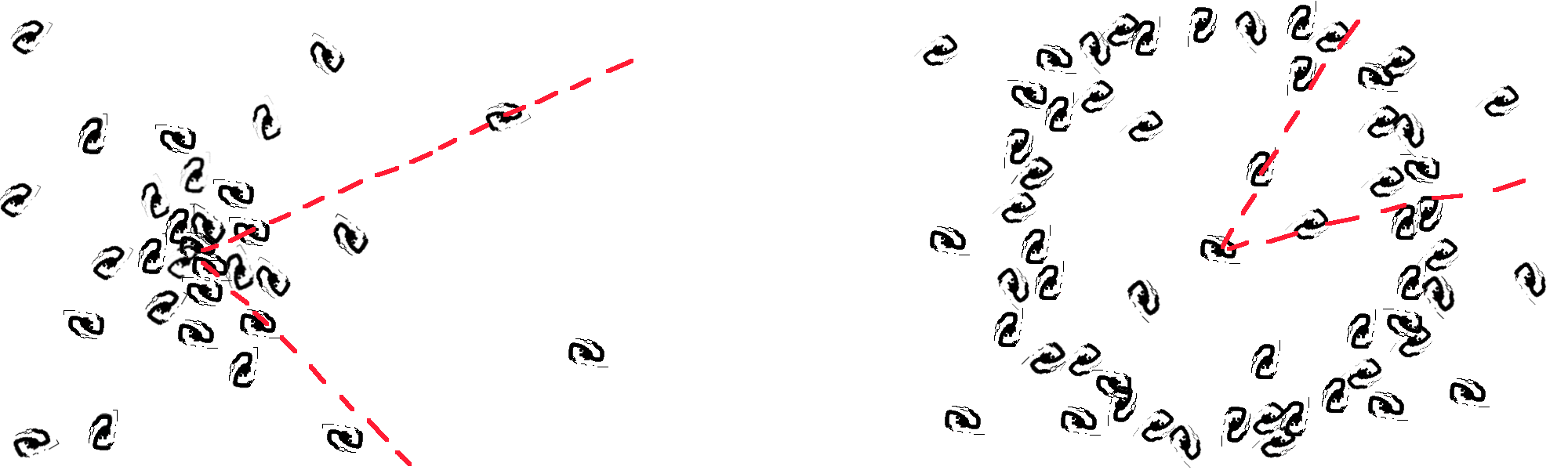
As John Rennie has taught us, Big Bang didn't happen at a point. However, if it did, and we happened to live in the central region, we could observe the same in all directions, but see a gradually thinnening universe, or maybe increasing to some point and then decreasing, depending on exactly how this exsplosion came about. This scenario would however imply that we inhabit a special place in the universe, which would make Kopernikus sad. If a universe is isotropic from more than one location, is must also be homogeneous.


inhomo-iso

Sunday, 8 January 2012

Where do new stars get their hydrogen from?

Stars only burn hydrogen in their core, where the temperature gets high enough for nuclear reactions to occur. They end their lives when they run out of fuel in the core, but lots of hydrogen still exists in their envelopes.


The Sun will burn 5-10% of its mass before exhausting its core. When this happens, the core will contract due to the radiation pressure disappearing. It then starts to burn hydrogen in a shell around the core. Eventually, when the Sun dies, it will have burned less than half of its hydrogen. Larger stars burn an even smaller fraction.


This means that, when stars die they still leave hydrogen behind for the next generation.


Galaxies can still run of of gas, though. Since after all, each $M_odot$ of star formed burns of the order of $1,M_odot$, if a galaxy isn't fueled with new gas it will become depleted on a timescale of order $1$ over its specific star formation rate sSFR, which is its star formation rate SFR measured in Solar masses per year, divided by its stellar mass $M_*$ in Solar masses:
$$
t_mathrm{depl} sim frac{1}{mathrm{sSFR}}=frac{M_*/M_odot}{mathrm{SFR}/M_odot,mathrm{yr}^{-1}}.
$$
For instance, a $10^9,M_odot$ galaxy with a star formation rate of $10,M_odot,mathrm{yr}^{-1}$ will become depleted of gas in roughly $10^8$ years.


Gas-depleted galaxies do exist, and the more depleted they are, the lower the star formation rate is (e.g. Rose et al. 2010), but in general the timescale is longer than the above, since galaxies also accrete gas from the surrounding circumgalactic medium.

the sun - Is it possible for the Sun and the Moon to crash into each other?

Technically speaking, only the Moon would crash into the Sun. That being said, it's certainty one of many possibilities in the far distant future.


About 7.6 billion years from now, the Sun will have ballooned to a large enough size to engulf much of the inner solar system. One of the consequences of growing into a small red giant will be mass lost due to a rapid sheding of material through a stronger solar wind. This mass loss will allow all of the planets to be pulled on by the Sun less, and they can achieve a higher orbit. In Earth's case, it could be as much as 1.2 AU from the center of the Sun. Also, there will eventually be a large increase in the solar wind density where Earth orbits the Sun. This solar wind and chromosphere will create drag on Earth while in motion around the Sun, and will rob the planet of its angular momentum (orbital velocity). The Earth will slowly begin to transition into a smaller orbit, and some sources think that this may lead to the Earth falling into the Sun.


In this scenario, Earth-Moon system is gravitationally stable, and the Earth has sufficient gravity to hold onto the Moon during this time - Earth will pull the Moon down with it.


What is not known to me is if the drag from the solar wind and chromospher will cause the Moon to lose enough angular momentum to spiral inwards, ultimately merging with the Earth before the Earth is engulfed by the Sun. This would be a spectacular sight, as the moon would first be ripped apart by the tidal interaction with Earth (inside the Roche limit, or about 11,500 miles from the center of the Earth). Our Moon would resemble a string of moonlets, each eventually falling to Earth. Either way, the result is the same - the Moon will only exist within the Sun.


Sources:


http://www.smithsonianmag.com/smart-news/earth-will-die-a-hot-horrible-death-when-the-sun-expands-and-swallows-us-and-now-we-know-what-that-looks-like-28965223/?no-ist


http://www.space.com/3373-earth-moon-destined-disintegrate.html

Thursday, 5 January 2012

cosmology - what is the current explanation for the formation of cosmic voids?

You might like to watch this short movie from one of the authorities on this subject:
https://www.youtube.com/watch?v=wI12X2zczqI


The movie starts by answering the question "what is the cosmic web and what does it look like?". Simulations can reproduce such structures, but they do not explain "why" they look the way they do. The clue lies in the geometric appearance of the structures: The voids resemble the elements of a Voronoi tessellation in which the walls of the Voronoi polyhedra intersect in lines that are identified with the filaments. We need to understand the dynamics that generated this pattern.


At around 2:30 the movie addresses the issue of why it looks the way it does using a simple ballistic model for the motion of a set of discrete particles that represent a random density field (the Zel'dovich model). The filaments are there but too fuzzy. So at ~3:00 it generalizes this so as to achieve greater realism by making the particles sticky. This is the "adhesion model", which is governed by the Burgers-Hopf equation, which is easily solved by geometric means. There is no gravity in this - it's ballistics acting on density field generated by a Gaussian Random process with a known covariance function (or power spectrum).


The adhesion model is a remarkable representation of the structure. It shows how nothing "special" is required to generate the pattern of the cosmic web. That's the "how".


The "why does the structure look like it does?" is a little more complex: this is the question of emergent geometry which is understood in terms of the technical language of the Lagrangian description of the flow. But the graphics is pretty and quite didactic, so worth a look. This happens after around 5:30.


The movie compares appearance of the flow simultaneously in both Lagrangian and Eulerian space. In the Lagrangian picture the particles have fixed coordinates,


A short descriptive article goes with the movie:
http://arxiv.org/pdf/1205.1669v1.pdf
and a short explanatin of the Lagrangiuan view is at
http://arxiv.org/pdf/1211.5385v1.pdf
This is part of the thesis work of Johan Hidding from the Kapteyn Instutue in Groningen (supevisor Rien van de Weygaert - the father of the cosmic web according to Richard Bond). A full presentation of the nature of the singularities in terms of Morse Theory is at
http://arxiv.org/pdf/1311.7134v1.pdf
and there are several other papers pending.

Wednesday, 4 January 2012

Super moon or Super lag?

This is the animation of the Moon's position over Los Angeles, CA skies at 8 p.m. local (PDT) time from September 25 to September 27, 2015 (made with Sky Map Online):


  Sky map


As you can see, there isn't any way to describe its apparent movement with a single angular distance, whichever method you use. In astronomy, position of objects on the night skies is most commonly given by RA/Dec (Right Ascension and Declination), which places an object on the celestial sphere.


Unless we count the Supermoon Eclipse on September 27, 2015 (your time, September 28 UTC), one that won't occur again until October 8, 2033, or exactly one saros period since the last one, there wasn't anything else as extraordinarily dramatic about the Moon's movement on those nights as you describe. So what happened is most likely that measurements by your observations weren't taken precisely enough; Be it you didn't time your observations precisely, didn't measure Moon's position relative to some fixed direction from some fixed vantage point, didn't project its position onto your scale taking the curvature of the celestial sphere into account, or a bit of any or all of these.


The Moon, if observed at the same solar time from the same location, moves in apparent eastward direction (when it's visible and above the horizon, westwards when it's below the horizon, regardless if that's during day or night) roughly 13° per day, or, saying it otherwise, each day, at the same time, it will appear to lag for about an hour relative to its position a day before. Why? Simply because it completes one orbit around the Earth every 27.321582 days, so at exact same solar time the next day, it will be 360°/27.321582 or 13.18° more East. Its apparent movement during the same day is of course still East to West, because the Earth rotates on its axis towards East much faster than the Moon rotates around the Earth.

Tuesday, 3 January 2012

galaxy - Acceleration in Galaxies Collision


Some questions pop up in my mind.


Can the gravitational interaction sling shot an entire stellar system?
How much Km/s2 we can expect these system to accelerate? (In a most
extreme plausible case).


Basically this comes down to gravity assists. A gravity assist is essentially a 3 body interaction. You need a point of reference and 2 velocities. When we send a spacecraft around a planet for a gravity assist, the point of reference is the sun. The maximum gravity assist velocity is (see picture), 2U+v.


enter image description here


Source.


I agree with James Kiflinger. Reaching galactic escape velocity is very unlikely because galaxies have large dark matter halos where most of the mass is contained and to actually escape all that requires a very high velocity. The vast vast vast, even with spiral arms extending outwards, still, most of the stars would stay in the gravitaitonal control of the merged galaxies.


From this question 0ur Sun orbits the center of the Milky way at 220 km/s and it's escape velocity 537 km/s so it would need an acceleration of 317 km/s to escape the Milky way. That kind of acceleration is possible given that Andromeda and Milky way will fly towards each other at something like escape velocity speed (537 km/s) - perhaps a bit more as Andromeda is larger, and there's orbital speed (similarish to our sun's 220 km/s), so there's enough velocity to kick a star out if the gravity assist is positioned just right, but you'd need a very heavy star, as a star the mass of our sun simply couldn't effect another star the mass of our sun if they fly past each other at several hundred km/s - the gravitational bend would be much less than 180 degrees, so you'd really need a very large sun, maybe a few dozen solar masses traveling at high speed to (maybe) kick another star out of the combined galaxy. Such an even would be hugely rare but theoretically possible. Now, an individual star could get multiple gravity assists, but 2 stars getting close enough for a good gravity assist would be rare enough, so that, a star actually being ejected, while it could happen, would be very rare. Certainly billions of stars per galaxy it could happen to a significant number of stars, but it would still be a 1 in a million (so to speak) event.


How this acceleration can affect the system? Can it de-stabilise
planet orbits for example?


First things first, accelerations are rare. For a star to accelerate around another star they need to get quite close and in such a scenario, the first thing you'd notice is there would be a 2nd sun in the sky, growing gradually brighter.


Even when Andromeda & the Milky Way collide, form the point of view of your average star, it wouldn't be very interesting unless you actually saw Andromeda's galactic core move towards you - then it might look cool but mostly it would just look like a bunch of stars - like we see in the sky today. The average closest distance between stars in our neck of the woods is maybe about 5-6 light years. In the center of the galaxy, less, but there's still a lot lot lot of space between stars, so even as Andromeda and Milky-way collide into each other, from one stars perspective, most of the time, all the stars would be quite distant and another star passing as close as 1 lightyear would be very rare - like maybe every million years or so, rare.


If our sun was to pass another similar star about 1 light year away, it would be bright in the sky but otherwise the effect would be negligible unless the star was very large.


For a sun like star to have the gravitational effect on Earth that Jupiter has (Jupiter is 4 AU from Earth at closest pass, our sun 1047 times the mass of Jupiter), 32 times further, about 128 AU, which is a teeny/tiny fraction of 1 light year, about 1/470. Even 100 solar masses, such a star would have to pass within 1/47th of a light-year to have the gravitational tug on Earth that Jupiter has. That's crazy-close and would be enormously rare. It would happen to some stars, but your average individual solar-system with life on it would on average not be effected in that way.


Luminosity could be more likely a factor than gravity, as a sun with 100 solar masses would be about a million times as luminous as our sun, and 1 million solar luminosity, to equal the solar output from our sun it would only need to pass within 1,000 AU or 1/60th of a light-year, and a sun that bright would put out lots of UV light. But even so, fly-bys that close would be very rare, but we would still be more likely to be cooked by a large star than orbitally perturbed by one. Smaller stars would need to fly much closer to have an effect, but smaller stars are also much more common.


Outer planets would be more vulnerable and oort cloud objects even more so, to near fly-bys and orbital perturbations, but again, that kind of near fly-by wouldn't happen often.


How it can affect life? Can it affect magnetosphere? change it's
shape? Can solar flares/wind get stronger in some path due particles
acceleration?


As stated, 2 stars would have to get unusually close for there to be any effect at all. The most likely any effect would be interactions between the two stars oort cloud, possibly leading to a big increase in comet collisions, which in and of itself could be pretty devastating when a good sized comet hits a planet. Such events would still be rare, but rather than every few million years, it might be every few thousand (ballpark guess).


Magnetosphere, doubtful. If a star gets close enough to affect a planet's magnetosphere, the planet would be vaporized.


Solar wind/solar flares - also, no measurable effect. A sun's solar flares are internally driven and not changed by objects flying past, especially at the distance of 2 stars even in a close flyby.


If another star passes really near (let's say 1 light year at closest
approach) but at great speed can its light reach that planet at high
energy levels, let's say x-ray and affect that planet life?


Again, no measurable effect. With the colliding of 2 galaxies you might see stars fly by each other at about 1000 km/s but that's nowhere close to enough velocity to create any kind of blue-shifted x-ray effect. Other than the night sky changing more rapidly over centuries than usual, there's no effect to stars flying past each other at 1000 km/s.


Mostly, there would be little to worry about. Star on star dangerously close fly-bys would be rare, even in a galaxy on galaxy collision.
Sunday, 1 January 2012

cosmology - How long would it take for a rogue planet to evaporate in the late stages of the Universe?

This page by physicist John Baez explains what will happen in the long term to bodies that aren't massive enough to collapse into black holes, like rogue planets and white dwarfs, assuming they don't cross paths with preexisting black holes and get absorbed. Short answer: they'll evaporate, for reasons unrelated to Hawking radiation. It's apparently just a thermodynamic matter, presumably due to the internal thermal energy of the body periodically causing particles on the surface to randomly get enough kinetic energy to achieve escape velocity and escape the body (the wiki article here mentions this is known as 'Jeans escape'). Here's the full discussion:


Okay, so now we have a bunch of isolated black dwarfs, neutron stars, and black holes together with atoms and molecules of gas, dust particles, and of course planets and other crud, all very close to absolute zero.


As the universe expands these things eventually spread out to the point where each one is completely alone in the vastness of space.


So what happens next?


Well, everybody loves to talk about how all matter eventually turns to iron thanks to quantum tunnelling, since iron is the nucleus with the least binding energy, but unlike the processes I've described so far, this one actually takes quite a while. About $10^{1500}$ years, to be precise. (Well, not too precise!) So it's quite likely that proton decay or something else will happen long before this gets a chance to occur.


For example, everything except the black holes will have a tendency to "sublimate" or "ionize", gradually losing atoms or even electrons and protons, despite the low temperature. Just to be specific, let's consider the ionization of hydrogen gas — although the argument is much more general. If you take a box of hydrogen and keep making the box bigger while keeping its temperature fixed, it will eventually ionize. This happens no matter how low the temperature is, as long as it's not exactly absolute zero — which is forbidden by the 3rd law of thermodynamics, anyway.


This may seem odd, but the reason is simple: in thermal equilibrium any sort of stuff minimizes its free energy, E - TS: the energy minus the temperature times the entropy. This means there is a competition between wanting to minimize its energy and wanting to maximize its entropy. Maximizing entropy becomes more important at higher temperatures; minimizing energy becomes more important at lower temperatures — but both effects matter as long as the temperature isn't zero or infinite.


[I'll interrupt this explanation to note that any completely isolated system just maximizes its entropy in the long term, this isn't true for a system that's in contact with some surrounding system. Suppose your system is connected to a much bigger collection of surroundings (like being immersed in a fluid or even a sea of cosmic background radiation), and the system can trade energy in the form of heat with the surroundings (which won't appreciably change the temperature of the surroundings given the assumption the surroundings are much larger than the system, the surroundings being what's known as a thermal reservoir), but they can't trade other quantities like volume. Then the statement that the total entropy of system + surroundings must be maximized is equivalent to the statement that the system alone must minimize a quantity called its "Helmholtz free energy", which is what Baez is talking about in that last paragraph--see this answer or this page. And incidentally, if they can trade both energy and volume, maximizing the total entropy of system + surroundings is equivalent to saying the system on its own must minimize a slightly different quantity called its "Gibbs free energy" (which is equal to Helmholtz free energy plus pressure times change in volume), see "Entropy and Gibbs free energy" here.]


Think about what this means for our box of hydrogen. On the one hand, ionized hydrogen has more energy than hydrogen atoms or molecules. This makes hydrogen want to stick together in atoms and molecules, especially at low temperatures. But on the other hand, ionized hydrogen has more entropy, since the electrons and protons are more free to roam. And this entropy difference gets bigger and bigger as we make the box bigger. So no matter how low the temperature is, as long as it's above zero, the hydrogen will eventually ionize as we keep expanding the box.


(In fact, this is related to the "boiling off" process that I mentioned already: we can use thermodynamics to see that the stars will boil off the galaxies as they approach thermal equilibrium, as long as the density of galaxies is low enough.)


However, there's a complication: in the expanding universe, the temperature is not constant — it decreases!


So the question is, which effect wins as the universe expands: the decreasing density (which makes matter want to ionize) or the decreasing temperature (which makes it want to stick together)?


In the short run this is a fairly complicated question, but in the long run, things may simplify: if the universe is expanding exponentially thanks to a nonzero cosmological constant, the density of matter obviously goes to zero. But the temperature does not go to zero. It approaches a particular nonzero value! So all forms of matter made from protons, neutrons and electrons will eventually ionize!


Why does the temperature approach a particular nonzero value, and what is this value? Well, in a universe whose expansion keeps accelerating, each pair of freely falling observers will eventually no longer be able to see each other, because they get redshifted out of sight. This effect is very much like the horizon of a black hole - it's called a "cosmological horizon". And, like the horizon of a black hole, a cosmological horizon emits thermal radiation at a specific temperature. This radiation is called Hawking radiation. Its temperature depends on the value of the cosmological constant. If we make a rough guess at the cosmological constant, the temperature we get is about $10^{-30}$ Kelvin.


This is very cold, but given a low enough density of matter, this temperature is enough to eventually ionize all forms of matter made of protons, neutrons and electrons! Even something big like a neutron star should slowly, slowly dissipate. (The crust of a neutron star is not made of neutronium: it's mainly made of iron.)